
Are you surrounded by plastic products but not sure what they are? You see them everywhere, but their creation process seems like a mystery.
A plastic mold product is an item created by injecting molten plastic resin, like ABS, PP, or PC, into a custom-made metal mold1. The plastic cools and hardens into the desired shape, resulting in a consistent, mass-produced part2 used in everything from phone cases to car bumpers.
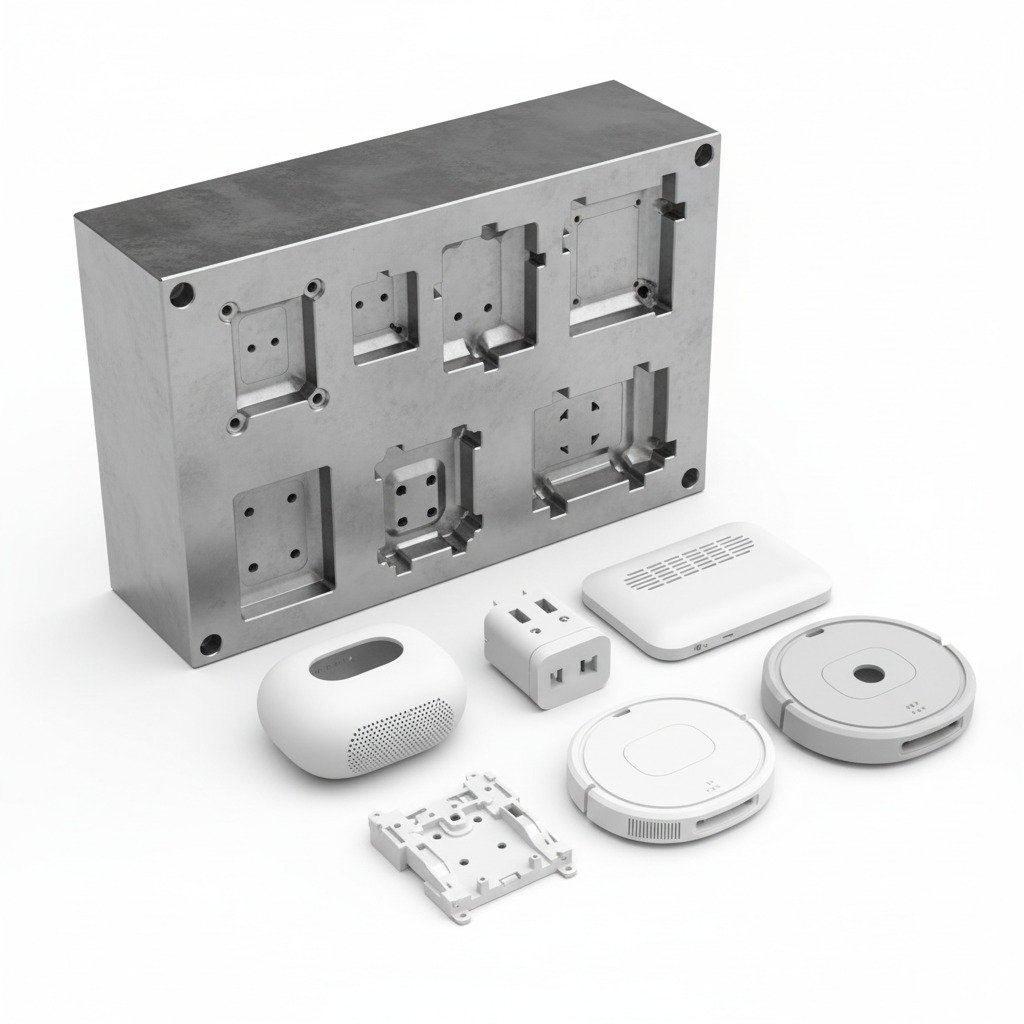
I've been in the mold-making business for over a decade, and I've seen it all. People often think of plastic as simple or cheap, but the technology behind creating these products is incredibly precise and complex. It's a world of high-tech machinery3, expert engineering, and amazing materials. This article will pull back the curtain and show you exactly what these products are, how they're made, and why they are so essential to our modern world. Let's get into it.
How are plastic products actually made with a mold?
You have a great idea for a new product, but how do you make thousands of them exactly the same? This is a huge challenge for many inventors and businesses.
The solution is injection molding4. This process uses a custom mold to shape plastic resin5 into a finished product with amazing speed and consistency. It's how nearly every plastic item around you, from your computer mouse to your coffee maker's casing, is born.
To really understand it, you have to see the process up close. I remember a client who came to our factory to see his first parts being made. He thought we just poured plastic into a box. When he saw the massive injection molding4 machine, the polished steel mold opening and closing, and the robotic arm plucking out a perfect part every 30 seconds, he was speechless. It’s not magic; it’s a highly refined engineering process. We start with a 3D design6 of the part. Then, our engineers use that design to create a high-precision mold, usually from steel. This is the most critical step. A good mold means good parts. Once the mold is ready, it's installed in an injection molding4 machine.
The process then follows a precise cycle:
The Injection Molding Cycle
The machine repeats these four steps over and over, producing a new part with each cycle. It's a symphony of heat, pressure, and timing.
| Step | Action | Description |
|---|---|---|
| 1. Clamping | The two halves of the mold are pressed together with immense force. | This ensures the mold stays shut during injection and prevents any plastic from leaking out. |
| 2. Injection | Molten plastic pellets are injected into the mold cavity under high pressure. | The plastic fills every tiny detail of the mold's shape. We use software like Moldflow7 to simulate this and make sure it fills correctly. |
| 3. Cooling | The mold is cooled, usually with water channels running through it. | The plastic solidifies and takes the final shape of the part. This is often the longest part of the cycle. |
| 4. Ejection | The mold opens, and ejector pins push the finished part out. | The part then falls onto a conveyor belt or is picked up by a robotic arm, and the cycle begins again. |
This process allows us to create millions of identical parts with incredible accuracy, down to ±0.01mm. It’s this precision and repeatability that makes injection molding4 the backbone of modern manufacturing.
Why do companies use plastic when metal seems stronger?
Many people believe metal is always the better choice for durability. They worry that using plastic will make their product feel cheap or break easily, hurting their brand's reputation.
However, modern plastics and advanced manufacturing techniques can create products that are not only strong but also look and feel premium. In fact, many companies choose plastic to reduce costs, lower weight, and achieve complex designs that would be impossible with metal.
I worked on a project for a high-end audio equipment company. They wanted to switch their speaker housing from machined aluminum to plastic to save costs. They were very worried about the look and feel. We suggested using a high-grade ABS plastic with an electroplated chrome finish. When we showed them the final prototype, they couldn't tell the difference between our plastic part and the original aluminum one just by looking. It had the same shine and premium feel, but it was 50% lighter and significantly cheaper to produce in large quantities. They were thrilled. This is a perfect example of how plastic is not a compromise but a smart engineering choice.
The Strategic Advantages of Plastic
The decision to use plastic over metal isn't just about saving a few dollars on material. It's a strategic choice that impacts the entire product lifecycle, from design to shipping. Let's break down the key differences for a common product, like a smart home device casing.
| Feature | Molded Plastic (e.g., PC/ABS) | Machined Metal (e.g., Aluminum) |
|---|---|---|
| Tooling Cost | Moderate to high initial mold cost. | Low initial setup cost for single units. |
| Per-Unit Cost | Very low at high volumes. | Very high, and does not decrease as much with volume. |
| Production Speed | Very fast (e.g., 30-60 seconds per part). | Very slow (e.g., minutes to hours per part). |
| Design Freedom | Extremely high. Can create complex curves, integrated snaps, and varying wall thicknesses easily. | Limited. Complex shapes are difficult and expensive to machine. |
| Weight | Lightweight. | Heavy. |
| Finishing Options | Huge variety: texturing, polishing, painting, electroplating, printing. | Limited to anodizing, painting, or polishing. |
As you can see, while the initial mold cost for plastic can be an investment, the savings in per-unit cost and the incredible production speed8 make it unbeatable for mass production. The design freedom9 is another huge factor. With plastic, we can design features like snap-fits directly into the part, which eliminates the need for screws and extra assembly steps. This saves time and money, and it often results in a cleaner-looking product.
Where are these plastic mold product10s hiding in plain sight?
You might think plastic parts are only for cheap toys or disposable containers. It can be hard to see the value and complexity of plastic products in a world full of high-tech gadgets.
The truth is, high-performance plastic mold product10s are everywhere, forming the essential structure of the most advanced and everyday items you use. From your smartphone to your car, and even in airplanes, precision molded plastics are critical components that make our modern lives possible.
One of the most interesting projects I ever worked on was for a robotics company. They needed a set of tiny, complex gears for the motor inside a robot's joint. The gears had to be incredibly precise, lightweight, and strong enough to withstand constant movement. We used a high-performance polymer11 called PEEK. This material is so strong and temperature-resistant that it's also used for parts in jet engines. Making the mold for those gears was a huge challenge. The tolerances were microscopic. But when we delivered the parts and they worked perfectly, it was a great reminder that "plastic" can mean so much more than a water bottle. It can be a cutting-edge engineering material.
A World Built with Molded Plastic
Let's explore where you can find these products. They are often the invisible heroes inside the devices we love, or the beautifully finished casings that we interact with every day.
| Industry | Common Products & Materials | Why Plastic is Used |
|---|---|---|
| Consumer Electronics | Phone cases (TPU, PC), smartwatch bodies (ABS), earbud housings (PC/ABS), charger casings (Fire-retardant PC). | Lightweight for portability, complex shapes for compact design, good for electrical insulation, and excellent surface finishes. |
| Home Appliances | Coffee machine shells (ABS), washing machine control panels (PMMA), refrigerator drawers (PP, PS), vacuum cleaner parts (ABS). | Cost-effective for large parts, chemical resistance against cleaning agents, and ability to be molded in various colors and textures. |
| Automotive | Dashboards (TPO), door handles (PA), bumpers (PP), engine covers (PA66+GF), light housings (PC). | Significant weight reduction to improve fuel efficiency, high impact strength for safety, and durability against weather and vibration. |
| Medical & Aerospace | Surgical tool handles (PEEK), medical device enclosures12 (Medical-grade PC), aircraft interior panels (Ultem), drone components (Carbon-fiber filled PA). | Sterilization compatibility, biocompatibility, extreme strength-to-weight ratio, and resistance to high temperatures and harsh chemicals. |
Each of these applications requires a specific type of plastic and a precisely designed mold. For a clear part like a car's headlight cover, we use Polycarbonate(PC) and polish the mold to a mirror finish. For a gear, we use a self-lubricating plastic like POM. The versatility of plastic molding is what allows for so much innovation across all these industries.
Conclusion
Plastic mold products are the foundation of modern manufacturing. They are versatile, precise, and cost-effective, making them essential for countless items we use daily, from simple cups to complex airplane parts.
Learn about the importance of custom molds in achieving precision in plastic manufacturing. ↩
Understanding mass production helps appreciate the efficiency of modern manufacturing. ↩
Explore how advanced machinery enhances the precision and efficiency of production. ↩
Explore the injection molding process to see how it shapes the products we use daily. ↩
Discover the different types of plastic resins and their applications in various industries. ↩
Learn how 3D design is crucial for developing accurate molds and products. ↩
Discover how Moldflow optimizes the injection molding process for better results. ↩
Understanding production speed can help businesses optimize their manufacturing processes. ↩
Explore how design freedom allows for innovative and complex product designs. ↩
Understanding plastic mold products reveals their significance in modern manufacturing and everyday items. ↩
Learn about high-performance polymers and their critical roles in advanced applications. ↩
Learn about the materials used in medical devices and their importance for safety. ↩