
Rapid Tooling vs. Production Tooling: Which One Gives Better ROI?
Choosing between rapid and production tooling is tough. A wrong move can drain your budget and delay your product launch, leaving you with a very expensive lesson.
The best ROI depends entirely on your production volume. Rapid tooling offers a lower initial cost for prototypes and small batches. Production tooling delivers a lower per-part cost for high-volume manufacturing, making it more profitable in the long run.
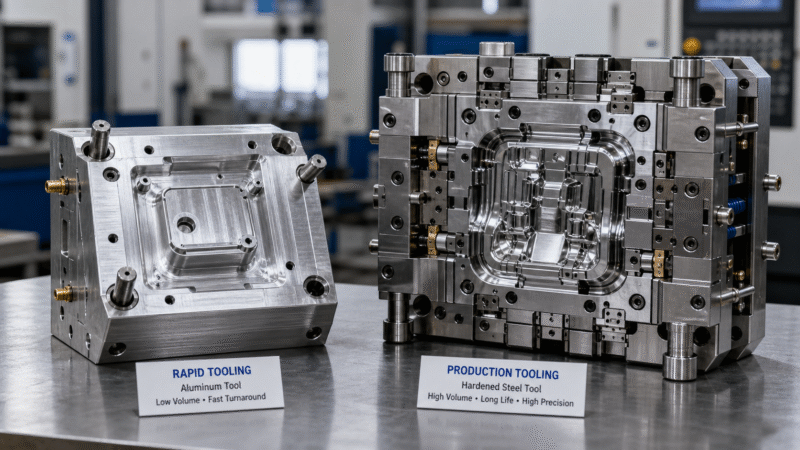
I've seen projects succeed or fail based on this single decision countless times. The choice isn't just about the upfront cost; it's about your entire manufacturing strategy and long-term goals. Getting it right from the start saves you headaches and money down the line. Let's break down when to use each type of tool so you can be confident you're making the right investment.
Best use cases for prototype, bridge, and mass production molds?
You have a new product idea, but you're not sure which mold type fits your stage. Picking the wrong one means wasting precious time and money on unnecessary features.
Use prototype molds for design validation with a few hundred parts. Use bridge molds for low-volume production or market testing up to 100,000 parts. Use mass production molds for anything beyond that to ensure long-term, high-volume manufacturing.
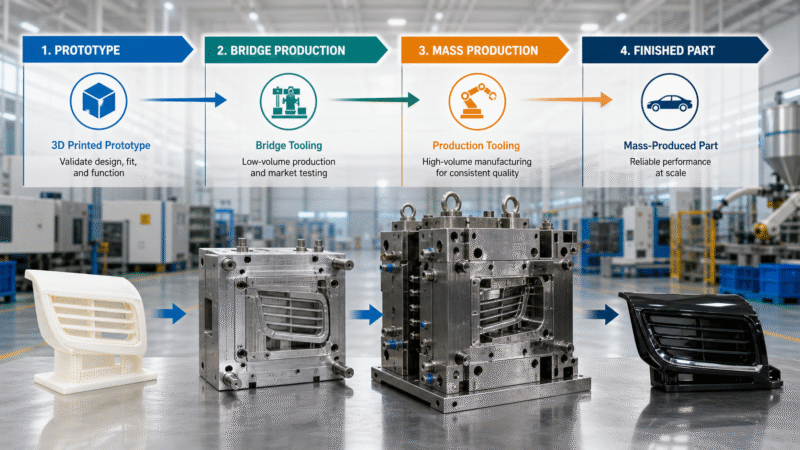
Understanding these three categories is critical. Each one serves a very specific purpose in a product's lifecycle. I once had a client who tried to stretch a prototype tool into a bridge production run. They were trying to save money, but after 5,000 shots, the part quality dropped dramatically because the softer tool steel started to wear down. They ended up having to pause production and pay for a new bridge tool anyway, which cost them more in delays and rework than if they had just chosen the right tool from the start.
Mold Types and Their Applications
Here's a simple breakdown to help you match the tool to the job:
| Mold Type | Best Use Case | Typical Volume | Primary Goal |
|---|---|---|---|
| Prototype Mold | Quickly testing form, fit, and function. Great for initial investor pitches or engineering validation. | 50 – 5,000 parts | Speed and Design Verification |
| Bridge Mold | Market testing, first production runs, or products with a shorter overall lifespan. | 5,000 – 100,000 parts | Balancing Cost and Volume |
| Mass Production Mold | Long-term, high-volume manufacturing where consistency and low part cost are critical. | 100,000+ parts | Durability and Lowest Cost-Per-Part |
Think of it as a ladder. You start with a prototype mold to make sure your design is solid. Once validated, you might move to a bridge mold to get your product on the market and gauge demand. If sales take off, you then invest in a mass production mold to scale up efficiently and maximize your profit margins. Each step is a calculated investment based on your project's maturity and risk level.
Tool steel, mold life, and maintenance differences?
The type of steel in your mold seems like a minor detail. But it directly impacts your mold's lifespan and maintenance costs, creating unexpected downtime and budget overruns later on.
Rapid tools often use softer aluminum or P20 steel for shorter runs. Production tools use hardened steels like H13 or S136 for millions of shots. This means rapid tools wear faster and need more repairs, while production tools are built for endurance.
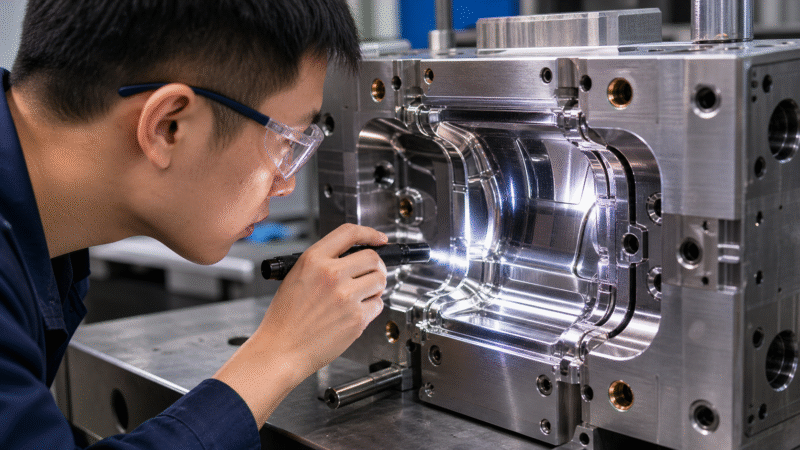
The material choice is the foundation of your tool's performance. Softer aluminum allows for very fast machining, which is why rapid tools can be made so quickly and cheaply. But it's also why they can't withstand the pressure and heat of high-volume production. Hardened steel tools take much longer to build because the steel is tougher to cut, but they pay you back with reliability over millions of cycles.
One thing I always warn clients about is the "hidden downtime" from some suppliers. If a mold maker tells you they need to stop production to replace a small component or re-apply a hardened layer, it’s often because the initial tool steel wasn't right for the job. This is a transparency gap that can be exploited to pad margins. Proper maintenance on a production tool should be scheduled far in advance, not be a surprise fire drill. I've also found that proactive design choices, like optimizing wall thickness and adding generous draft angles, reduce the physical stress on the mold. This simple step helps extend the life of any tool, whether it's made from P20 or H13 steel.
How part volume changes the break-even point?
You're trying to calculate your total manufacturing cost, but the math is confusing. Choosing the wrong tooling based on a flawed cost analysis can completely destroy your profit margins per part.
The break-even point is where the higher cost of a production tool is offset by its lower per-part price. As your volume increases, the expensive production tool quickly becomes the more profitable choice for mass production.
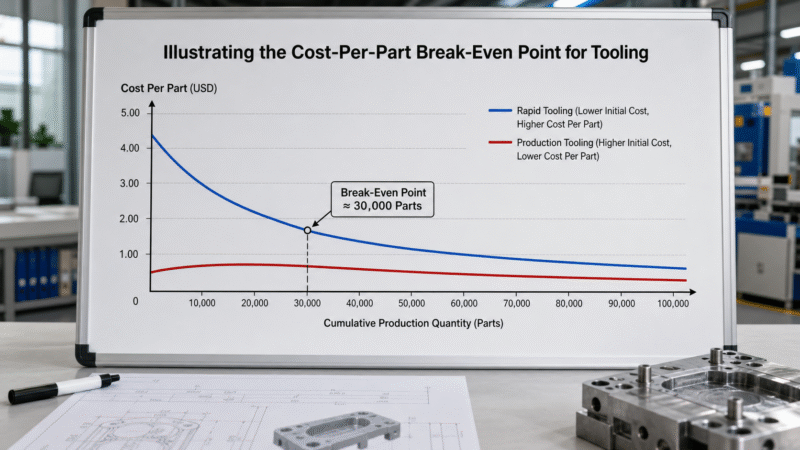
Let’s look at a very simple example. Imagine a rapid tool costs $5,000 and the price per part is $2.00. A production tool for the same part might cost $50,000, but the price per part is only $0.50. At first, the rapid tool looks like a bargain. But as you produce more parts, the math changes. The break-even point is the volume where the total cost of both options is the same. In this case, it's at 30,000 units. If you plan to make more than 30,000 parts, the production tool gives you a much better ROI.
But this basic calculation doesn't tell the whole story. It ignores maintenance, downtime, and quality issues. In my experience, practical adjustments during the initial production runs (T1-T3) can make a huge difference. For one project, we found that by slightly optimizing the cooling time and adjusting the slide and lifter travel speeds, we could reduce cycle time without putting extra stress on the mold. These were non-standard tunings that didn't add to the budget but significantly mitigated accelerated wear on a bridge tool, effectively pushing its break-even point further out and saving our client a lot of money.
Decision matrix for startups and established OEMs?
As a startup, your needs are completely different from those of a huge OEM. Using the same decision-making process can lead to buying a tool that's either too weak or too expensive.
Startups should prioritize rapid tooling for speed, low initial cost, and design flexibility. Established OEMs should invest in production tooling for high volume, long-term stability, and the lowest possible cost per part, leveraging their predictable demand.
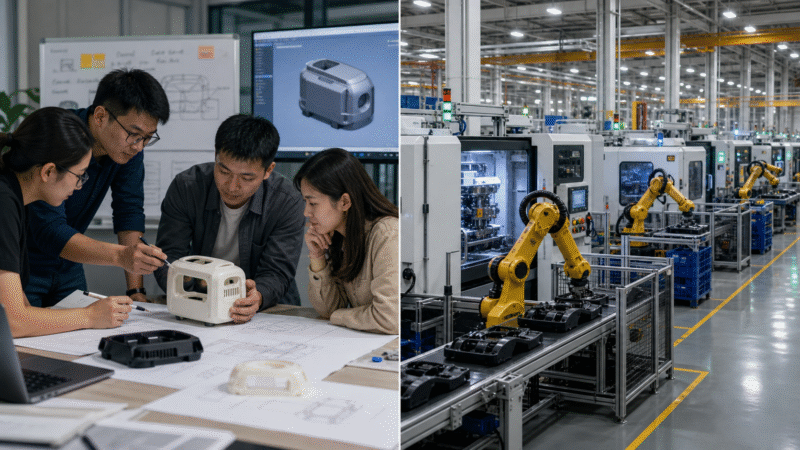
The right choice depends on your business model and where you are in your growth journey. A startup is all about speed and validation. They need to get a physical product into the hands of early customers as fast as possible to test the market and secure funding. They can't risk a massive upfront investment in a production tool for a product that might need design changes or might not even sell. Flexibility is their greatest asset.
An established OEM, like a car manufacturer, operates on a different plane. They have proven demand and plan product lifecycles years in advance. For them, the top priority is producing millions of identical, high-quality parts at the lowest possible cost over a long period. They need a robust, reliable production tool that can run 24/7 with minimal downtime. For them, the initial tool cost is just one part of the total lifecycle cost calculation.
Decision-Making Priorities
This table shows how priorities differ between the two types of companies:
| Factor | Startup Priority | OEM Priority | Recommended Tooling |
|---|---|---|---|
| Initial Cost | High (Keep it low) | Low (Focus on part price) | Startup: Rapid, OEM: Production |
| Speed to Market | High (Need it now) | Medium (Predictable schedule) | Startup: Rapid, OEM: Production |
| Production Volume | Low (Uncertain demand) | High (Mass production) | Startup: Rapid/Bridge, OEM: Production |
| Design Changes | High (Expect iterations) | Low (Design is frozen) | Startup: Rapid, OEM: Production |
| Long-Term Part Cost | Low (Focus on initial cost) | High (Key to profitability) | Startup: Rapid, OEM: Production |
Conclusion
Choosing the right tool is about matching your production volume, budget, and business goals. Rapid tooling is for speed and low volume. Production tooling is for long-term manufacturing and better ROI.